 Guide: rodents and rabbits


What to buy
- hay for rodents: The basis of the daily diet of rabbits, guinea pigs and chinchillas.
- MEGI mixes: Mixes for hamsters, rabbits and guinea pigs, given as a supplement to hay.
- Złota Seria Rabbit: Rabbit food as a supplement to hay, given in a measured portion.
In this article
- What is the difference between food for rabbits, guinea pigs, chinchillas and hamsters?
- Why is hay the basis of the diet of rabbits, guinea pigs and chinchillas?
- How should I give a seed mix to rodents?
- How many vegetables and fruit can a rodent have?
- Where does a guinea pig get vitamin C?
- How should I change food and when should I see a vet?
- Frequently asked questions
What is the difference between food for rabbits, guinea pigs, chinchillas and hamsters?
Rabbits, guinea pigs and chinchillas live mainly on hay, and a hamster on pellets or a seed mix prepared for hamsters1,4,6,8. So no single "rodent" food suits all animals.
| Animal | Basis of the diet | Pellets or mix | What to watch out for |
|---|---|---|---|
| rabbit | hay and grass, about 85%1,2 | about 5% of the diet1, PDSA: a tablespoon a day2 | carrots every day1 |
| Guinea pig | hay, 85-90%4 | a tablespoon of pellets with vitamin C a day4 | food without vitamin C4 |
| chinchilla | grass hay, e.g. timothy, unlimited6 | 1-2 tablespoons of pellets a day6 | fruit above 10% of the diet6 |
| hamster | pellets or a seed mix for hamsters8 | as above, plus small amounts of greens and vegetables8 | grapes and rhubarb8 |
Always check on the label which animal the food is for. We describe the details for each species in our guides starter kit for a rabbit, what to feed a chinchilla and what a hamster needs.
Why is hay the basis of the diet of rabbits, guinea pigs and chinchillas?
Because the teeth of these animals grow throughout their lives, and hay wears them down, as the RSPCA writes about chinchillas7. Merck recommends unlimited hay for a rabbit, low in calcium, for example timothy, as 85-90% of the diet3.
PDSA states that a rabbit should get every day at least a bundle of hay the size of its own body2. Too many pellets means the rabbit eats less hay, and this promotes overgrown teeth and gut stasis2.
Give a chinchilla fresh grass hay every day and store it in a dry, airy place6. Merck advises avoiding lucerne hay6.
At domowypupil.pl
-
For small animals
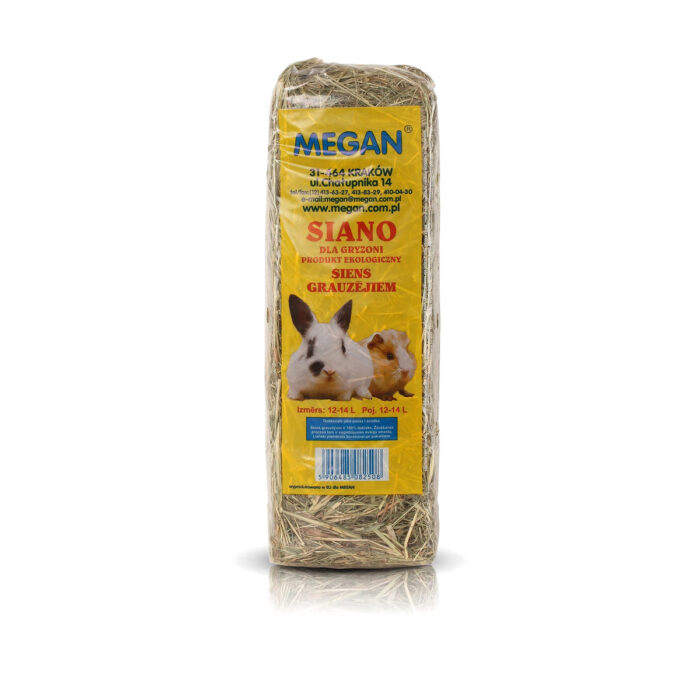
Hay for rodents
6,00 zł incl. VAT Add to basket
How should I give a seed mix to rodents?
For a rabbit, guinea pig or chinchilla, give any food, including a mix, as a supplement to hay, in a small portion1,4,6. For a hamster, the RSPCA allows pellets or a seed mix prepared for hamsters8.
A hamster can eat a mix every day, while a rabbit, guinea pig and chinchilla get it in a small portion alongside hay.
The shop offers MEGI mixes for hamsters, rabbits and guinea pigs, as well as the Złota seria range for rabbits. Check on the packaging which species the food is for and what portion it recommends.
The other rodent foods in the shop differ by species and type, so before buying check on the label who the food is for:
- Staple food for rodents, according to the shop description a grain and vegetable mix,
- Exclusive, a complementary supplement to the main food, not a substitute for it,
- Megan Variete, mixes for rodents,
- Złota Seria for rats, rat food,
- Złota Seria Degu, degu food.
How many vegetables and fruit can a rodent have?
Not much, and the amount depends on the species. For a rabbit the RSPCA gives about 10% of the diet as leafy vegetables, and PDSA a handful of greens twice a day from 5-6 kinds1,2.
- Rabbit: carrots only occasionally, fruit rarely and without stones1,2.
- Guinea pig: about a cupful of vegetables a day from 5-6 kinds, carrot as a treat once or twice a week4.
- Chinchilla: a handful of dark green lettuce, fruit below 10% of the diet6.
- Hamster: small amounts of greens, washed root vegetables and pieces of fruit, without grapes and rhubarb8.
PDSA warns that cabbage and broccoli can cause bloating in guinea pigs4. For a rabbit, PDSA recommends changing the diet slowly2.
Where does a guinea pig get vitamin C?
From guinea pig pellets with added vitamin C and from vegetables and herbs4,5. PDSA states plainly that guinea pig pellets should contain vitamin C4.
Vitamin C breaks down over time and in air, so the RSPCA advises giving fresh pellets every day5. PDSA recommends storing food in a dry, cool and dark place and using it within 3 months4.
PDSA regards vitamin C supplements as optional with a good diet and does not recommend adding them to water4. Decide on supplements together with your vet.
How should I change food and when should I see a vet?
Change food slowly. Introduce new foods to a chinchilla over a few days, and for a hamster avoid sudden changes of diet and stale food6,8.
Fresh water should always be available, ideally in a bottle with a spout for a hamster, and wash a chinchilla's bottle every day6,8. The RSPCA also advises scattering or hiding some of a hamster's food so that it does not get bored8.
If a hamster loses its appetite or has wet droppings, contact a vet straight away8. Do the same if a rabbit, guinea pig or chinchilla stops eating. You will find food, hay and treats in the category food for rodents and rabbits.
Key points
- Rabbits, guinea pigs and chinchillas live mainly on hay.
- A guinea pig needs pellets with vitamin C.
- Always check on the label which animal the food is for.
- Change food slowly.
Frequently asked questions
Is one rodent food enough for both a rabbit and a hamster?
No. A rabbit lives mainly on hay and gets few pellets, while a hamster eats pellets or a seed mix for hamsters. Choose food intended for the particular species.
How many pellets should I give a guinea pig?
PDSA recommends about a tablespoon of pellets a day, with added vitamin C. The basis of the diet is hay, which makes up 85-90% of the food.
Can a rabbit eat carrots?
Only occasionally, because carrots contain a lot of sugar. The RSPCA and PDSA do not recommend them as everyday food.
What should I not give a hamster?
The RSPCA lists grapes and rhubarb. Also avoid sudden changes of diet and stale food.
Sources
- RSPCA, "Rabbit diet", rspca.org.uk
- PDSA, "Your rabbit's diet", pdsa.org.uk
- Merck Veterinary Manual (owners' version), "Diet for rabbits", merckvetmanual.com
- PDSA, "Your guinea pig's diet", pdsa.org.uk
- RSPCA, "Guinea pig diet", rspca.org.uk
- Merck Veterinary Manual (owner version), "Diet for a Chinchilla", Laurie Hess, DVM, DABVP, merckvetmanual.com
- RSPCA, "Keeping chinchillas as pets", rspca.org.uk
- RSPCA, "Keeping hamsters as pets" and subpages "Hamster environment" and "Hamster diet", rspca.org.uk
Photos: photo: Takkiln, Wikimedia Commons, CC BY-SA 4.0, crop changed; photo: Padaguan, Wikimedia Commons, CC BY-SA 4.0, crop changed; photo: Gzen92, Wikimedia Commons, CC BY-SA 4.0, crop changed.
Prepared by the domowypupil.pl editorial team on the basis of the sources listed above. The article is for information only and does not replace the advice of a vet.